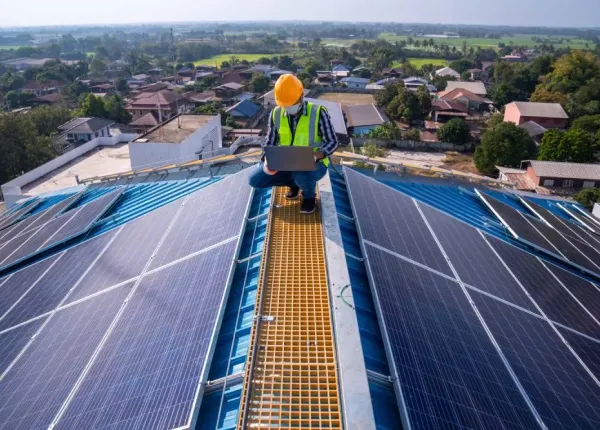
Tax Planning for Businesses: The ROI of Commercial Solar Panels Installation
Tax Planning for Businesses: The ROI of Commercial Solar Panels Installation
Investing in a commercial solar panels installation is one of the most effective strategies Hawaii business owners can leverage to drastically cut operating costs while capitalizing on generous state and federal tax credits.
On Oahu, where utility rates are among the highest in the nation, installing commercial solar panels transforms an unpredictable overhead expense into a high-yield, long-term financial asset.
For local businesses, rising energy costs directly erode profit margins and limit capital growth. Transitioning to commercial roof solar panels or flat roof solar installation allows property owners to shield their bottom line from utility rate spikes, claim up to 65% in combined tax incentives, and accelerate equipment depreciation through MACRS.
In this guide, you will learn how a custom commercial solar panels installation generates a measurable return on investment, how to maximize Hawaii’s specific tax benefits, and how to evaluate the long-term financial impact on your property. Here is a closer look at how commercial solar roof panels turn sunlight into substantial tax savings.
Unlocking Business Value: What Is Commercial Solar Energy?
A commercial solar panels installation converts standard solar radiation into usable, high-grade electricity for corporate facilities, industrial warehouses, retail spaces, and multi-tenant properties.
By mounting an array of solar roof panels on commercial buildings or utilizing a flat roof solar installation, businesses can generate their own clean power directly where it is consumed.
In Hawaii's commercial sector, energy overhead represents one of the largest controllable operational expenses. Utility rates across Oahu continue to fluctuate, directly eroding net profit margins.
Investing in custom solar panels on commercial rooftops projects allows business owners to lock in predictable energy costs, insulate their operations from rate volatility, and transform an ongoing operational burden into a high-yield capital asset.
Key financial and strategic advantages include:
- Substantial Overhead Reduction: Immediately lower monthly electric utility expenditures to protect operating capital.
- Aggressive Tax Incentives: Combine the 30% Federal Investment Tax Credit (ITC) with Hawaii's 35% state tax credit to offset major capital outlays.
- Accelerated Asset Depreciation: Capitalize on Modified Accelerated Cost Recovery System (MACRS) tax write-offs over a five-year period.
- Enhanced Commercial Property Value: Capitalize on increased building equity and improved sustainability profile.
A common oversight among property managers is viewing a commercial solar panels installation purely as a building maintenance cost rather than a strategic financial tool. Exploring dedicated commercial solar solutions allows companies to systematically design an array structured for maximum tax efficiency.
Furthermore, integrating tailored commercial energy infrastructure ensures excess energy captured during peak daylight hours is stored to mitigate expensive utility demand charges.
Strategic Financial Returns: Navigating the Tax Advantages of Commercial Solar
Evaluating a commercial solar panels installation requires looking beyond basic utility savings to analyze the significant tax advantages available to Hawaii businesses. Federal and state incentives drastically shorten the payback period, converting a commercial roof mounted solar panels system into a high-ROI financial asset.
1. Capitalizing on the Federal Investment Tax Credit (ITC)
The Federal Investment Tax Credit (ITC) serves as a primary driver for installing commercial solar panels. Under current federal legislation, qualified commercial projects receive a 30% tax credit applied directly against corporate federal income tax liability.
- Dollar-for-Dollar Reduction: Unlike a tax deduction that simply lowers taxable income, this credit directly reduces federal income tax dollar-for-dollar.
- Tax Carryforward Options: If your business cannot utilize the entire 30% credit in the tax year the system is placed in service, excess credits can generally be carried back one year or carried forward for up to 20 years.
- Bonus Adders: Additional tax credit bonuses may apply depending on meeting specific domestic content parameters or energy community location criteria, pushing the total federal tax credit higher.
2. Maximizing Hawaii State Business Tax Incentives
In addition to federal credits, Hawaii offers a State Energy Tax Credit that provides a 35% tax credit for commercial solar roof panels, capped at site-specific per commercial system.
Combining the federal 30% credit with state incentives allows business owners to cover a massive portion of the gross system costs in the first year alone. Maximizing these state credits requires precise engineering and local expertise.
Working with experienced, in-house experts in licensed electrical services ensures every system is installed to meet strict local utility interconnections and building codes, avoiding costly tax reporting delays.
3. Accelerated Asset Depreciation via MACRS
Beyond direct tax credits, the Modified Accelerated Cost Recovery System (MACRS) significantly enhances the ROI of industrial solar panel installation. Solar PV equipment qualifies for a 5-year MACRS schedule, allowing companies to write off the depreciable basis of the asset at an accelerated rate.
- Basis Adjustment Rule: When claiming the 30% Federal ITC, the depreciable basis of the solar asset is reduced by only half the credit amount (a 15% reduction). This leaves 85% of the total system cost available for accelerated depreciation.
- Taxable Income Offset: Accelerating depreciation lowers taxable corporate income during the critical first few years of operation, freeing up cash flow to re-invest in core business operations.
4. Mitigating Operational Risks with Integrated Upgrades
Commercial property managers often discover during the engineering phase that older roofs require structural maintenance before mounting solar panel roof installation arrays. Pairing roof remediation directly with your solar project can streamline your capital investment.
Integrating certified commercial roofing solutions prior to placing solar panels on business roofs ensures structural integrity, avoids unnecessary re-roofing expenses midway through the system's 25-year lifecycle, and consolidates installation timelines under one accountable team.
5. Calculating Total Net Cost and Real ROI
When evaluating installing commercial solar panels, the actual out-of-pocket investment is only a fraction of the gross system price.
For example, on a site-specific commercial installation:
- 30% Federal ITC: -site-specific
- Hawaii State Tax Credit (35%): -site-specific
- MACRS Depreciation Tax Savings (assuming ~21% corporate tax rate): -site-specific
- Net Out-of-Pocket Cost: Approx. site-specific
When factored against Hawaii’s commercial electric rates, a properly structured solar array often reaches full payback within 3 to 5 years, delivering positive cash flow and clean energy generation for decades afterward.
Real-World Application: Commercial Solar Investments in Action
Translating tax incentives into bottom-line profits requires understanding how different commercial entities structure their projects. Here is how Hawaii business owners apply these tax strategies to solve operational challenges and reduce overhead.
A distribution warehouse in Kapolei faced escalating monthly electricity bills exceeding site-specific due to intensive refrigeration demands. The owner completed a flat roof solar installation paired with integrated energy storage to shave off peak demand charges.
By utilizing the 30% Federal ITC, Hawaii’s 35% state tax credit, and 5-year MACRS depreciation, the company recovered over 60% of the project costs within the first tax year, locking in stable operating expenses.
An owner of an office building in Honolulu needed to upgrade a aging roof while reducing electricity overhead for tenants. By coordinating a project through experts in solar-integrated roofing services, the property owner consolidated roof repair and PV installation under one timeline. This approach mitigated future leak risks, boosted property value, and yielded immediate cash flow through offset utility expenses.
Additionally, a local retail center in Ewa Beach deployed commercial roof solar panels across its parking structures and main building to lower shared utility expenses. The direct tax savings immediately freed up working capital to fund business expansion and tenant improvements.
These real-world scenarios demonstrate that a commercial solar installation is a practical, high-return investment that delivers immediate cash-flow relief and long-term asset value.
Maximizing Your ROI: Best Practices for Commercial Solar Installations
Transitioning from financial forecasting to active implementation requires strategic planning. Following these industry best practices ensures your business captures maximum tax incentives while securing long-term operational performance.
- Schedule Early to Align with Tax Deadlines: Commercial solar projects require precise engineering, permitting, and utility interconnection approvals. Securing your placement well ahead of tax year cutoffs ensures your commercial solar panels installation is commissioned in time to claim first-year tax credits and MACRS depreciation benefits.
- Audit Roof Conditions Before Mounting Systems: Installing solar panels on commercial rooftops that require repairs within 5 to 10 years creates unnecessary operational expenses. Conducting a structural audit and pairing roof upgrades with certified solar-integrated roofing services protects the building structure and avoids mid-lifecycle removal fees.
- Design for Peak Demand and Future Capacity: Energy usage rarely remains static. Structure your array size and battery storage options around your highest peak demand charges rather than baseline usage to optimize utility savings.
- Work Exclusively with In-House Journeymen: Subcontracted installations often lack consistent quality control and local accountability. Utilizing dedicated, licensed electrical journeymen guarantees that high-voltage interconnections meet strict Hawaii building codes and safety regulations.
Applying these best practices ensures your project proceeds smoothly from concept to commissioning, protecting your capital investment and maximizing long-term energy returns.
Securing Your Energy Independence: Take Action on Commercial Solar Today
Investing in a commercial solar panels installation provides Hawaii businesses with a proven framework to convert volatile utility expenses into long-term financial equity. By leveraging the 30% Federal Investment Tax Credit, Hawaii’s 35% state tax credit, and accelerated MACRS depreciation, property owners can reclaim the majority of their initial system costs in the first year alone.
With commercial utility rates continuing to rise across Oahu, delaying your installation directly increases operational overhead and exposes your business to ongoing rate hikes. Securing your commercial solar project today ensures you lock in maximum tax incentives, lower your operational expenses, and build lasting grid independence.
Partnering with an experienced, locally owned installer is the most critical step in maximizing your financial return. Explore how our custom commercial solar solutions can help your business optimize tax incentives, lower operating costs, and secure long-term energy stability.
Commercial Solar Tax Incentives: Frequently Asked Questions
What tax incentives are available for commercial solar panels installation in Hawaii?
Businesses investing in a commercial solar panels installation can stack several major incentives: the 30% Federal Investment Tax Credit (ITC), Hawaii's 35% state tax credit (capped at site-specific per commercial system), and accelerated 5-year MACRS depreciation. Combined, these tax benefits typically offset 60% to 85% of total gross system costs in the first year alone.
How does MACRS depreciation work when installing commercial solar panels?
Under federal tax law, qualified solar equipment follows a 5-year MACRS schedule. When claiming the 30% Federal ITC, the system's depreciable basis is reduced by half the credit value (15%). This allows your business to write off 85% of the gross cost over five years, significantly lowering corporate taxable income and boosting cash flow.
Can a flat roof solar installation support commercial roof mounted solar panels?
Yes, flat roof solar installation projects are ideal for commercial roof mounted solar panels. Ballasted or attached racking systems tilt panels at optimal angles for sun exposure without compromising structural integrity. Pairing system design with specialized commercial roofing services ensures the roof remains watertight, durable, and ready to support long-term clean energy generation.
How quickly does an industrial solar panel installation achieve full ROI?
When factoring in Hawaii's high commercial electricity rates alongside federal tax credits, state incentives, and MACRS tax savings, most industrial solar panel installation projects achieve full financial payback in 3 to 5 years. Beyond the payback period, the system delivers decades of virtually free electricity, directly boosting net profit margins.
About the Author
Ryan Malaluan, CAPM®, is an SEO & Content Strategist with over 8 years of experience in SEO, content strategy, and digital marketing. He holds a Bachelor of Arts in Literature and is a Certified Associate in Project Management (CAPM®). Throughout his career, Ryan has worked with brands including Spacer, Airtasker, Marlee (formerly Fingerprint for Success), VEED.IO, and ROSEMET LLC, as well as several digital marketing agencies, helping businesses strengthen their organic visibility through strategic, results-focused SEO and content.